Uttarakhand Model Gets National Recognition as Ajaey Kumar Takes Charge of Rajasthan Organisation
 Brandon Brooks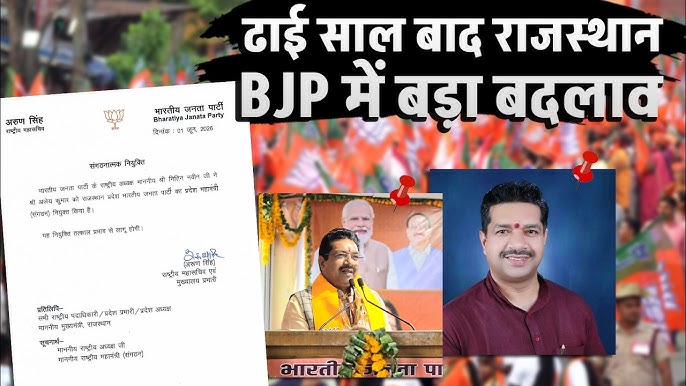
Ajaey Kumar BJP appointment to a key organisational role in Rajasthan is being seen as national recognition of the organisational model developed by the Bharatiya Janata Party in Uttarakhand during his tenure. The decision reflects the central leadership’s confidence in his ability to build disciplined structures, maintain worker engagement and ensure coordination between different levels of the party. For the Uttarakhand BJP, the move is also being viewed as an acknowledgement of the state unit’s strong performance in recent years.
The term “Uttarakhand model” in this context refers to a style of organisational functioning that placed emphasis on discipline, grassroots communication, booth-level preparation, regular travel and coordination between the government and the party. Uttarakhand is not an easy state for political organisation. Its terrain is difficult, its population is spread across hills, valleys, border districts and urban centres, and several areas require sustained effort to maintain regular political contact. Building an active organisation in such conditions requires patience and continuous engagement.
Ajaey Kumar’s tenure in Uttarakhand is associated with this steady and structured approach. The party organisation did not remain confined to major cities or state-level meetings. Efforts were made to keep district, mandal and booth-level units active. Workers in remote areas were kept connected through regular programmes, meetings and campaigns. This helped the BJP maintain a living organisation rather than a structure that became visible only during elections.
One of the most important features of this model was year-round activity. Political parties often become highly active during elections but lose momentum in between. Under Ajaey Kumar’s organisational guidance, the Uttarakhand BJP sought to avoid this pattern. Membership campaigns, training programmes, national campaigns, service initiatives, booth meetings and public outreach efforts were carried out consistently. This gave workers a regular role and kept the organisation in a state of preparedness.
The focus on booth-level strength was another defining element. In the BJP’s political strategy, the booth is not just an election-day unit; it is the point where the party connects most directly with voters. A strong booth structure helps the organisation understand local issues, identify public sentiment and mobilise support effectively. In Uttarakhand, booth committees and
local-level workers were given importance, which strengthened the party’s ground presence across regions.
Ajaey Kumar also paid attention to organisational discipline. In a state where the party was in power, managing expectations among workers and local leaders was important. Power often creates competing ambitions, and if not handled carefully, these can weaken internal unity. The Uttarakhand BJP largely avoided major organisational controversies during his tenure. This is being viewed as an achievement, especially because the state also witnessed changes in political leadership.
The continuity of the organisation during leadership changes is one of the strongest arguments in favour of Ajaey Kumar’s organisational success. Changes at the level of chief minister and state president could have affected the party’s functioning. However, the organisational machinery remained active and stable. Workers continued to participate in programmes, and communication between different levels of the party did not break down. This ability to maintain stability during transition appears to have impressed the national leadership.
Government-organisation coordination was another important part of the Uttarakhand model. For a ruling party, it is not enough for the government to announce schemes or take decisions. Those decisions must reach the public, and the organisation plays a major role in that process. At the same time, workers on the ground must be able to communicate public feedback to the leadership. Ajaey Kumar is believed to have helped keep this communication active, ensuring that the organisation remained connected both to governance and to the grassroots.
His appointment to Rajasthan suggests that the BJP central leadership sees value in applying some of these organisational principles to a larger and politically more complex state. Rajasthan is very different from Uttarakhand in scale and social composition. It has a much larger geographical spread, multiple political regions, strong caste and community dynamics and intense electoral competition. Yet the basic requirements of organisation remain the same: active workers, disciplined units, clear communication, booth-level strength and coordination with leadership.
Rajasthan will therefore be a major test of Ajaey Kumar’s organisational skills. He will have to work in a broader environment, with more layers of leadership and a larger cadre base. The challenge will not only be to maintain activity but also to ensure alignment across different regions and organisational units. His experience in Uttarakhand may help him approach this task with patience and structure.
The appointment also strengthens the message that the BJP values organisation as much as public leadership. While elected leaders and public figures are visible in politics, organisation ministers often work behind the scenes. Their role is to keep the party’s internal machinery strong, ensure that programmes are implemented and maintain the energy of the cadre. Ajaey Kumar’s rise reflects the importance of this role within the BJP.
For workers in Uttarakhand, his new responsibility is being seen as a matter of pride. It indicates that the work done in the state has been noticed beyond its borders. A state that is often viewed as small in electoral size has produced an organisational example that the national leadership
considers significant enough to be linked with Rajasthan. This recognition can also motivate the Uttarakhand unit to continue strengthening its organisational practices.
The move also sends a message to other state units. Organisational discipline, continuous worker engagement and strong booth-level functioning are not routine internal matters; they can shape a leader’s future within the party. Ajaey Kumar’s journey shows that sustained work at the organisational level can lead to major responsibilities.
In the larger picture, Ajaey Kumar’s appointment to Rajasthan is both a reward and a challenge. It rewards the work done in Uttarakhand and challenges him to deliver in a much bigger political landscape. The Uttarakhand model has earned national recognition, but its principles will now be tested in Rajasthan. How effectively he adapts them will determine the next phase of his organisational journey.